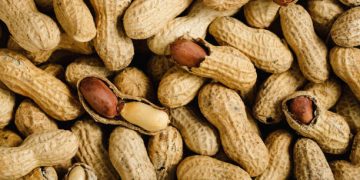






Tariff-free imports of peanuts from the United States could affect up to 30 percent of domestically produced peanuts, Taiwan’s Ministry of Agriculture (MOA) said, as it outlined measures to increase the value of local produce and guide potential crop adjustments.
The tariff-free imports are included in the proposed US-Taiwan Agreement of Reciprocal Trade (ART), which still requires approval by the Legislative Yuan.
Addressing concerns about increased imports once the agreement takes effect, Deputy Minister of Agriculture Hu Chung-yi said the government plans to support the sector’s transition and maintain the competitiveness of locally produced peanuts.
If implemented, the agreement could affect an estimated 20 to 30 percent of domestic production, he said. Peanut farming in Taiwan is mainly concentrated in Yunlin and Changhua counties, where planted areas have declined in recent years due to labor shortages. Ministry data show peanut cultivation covered about 19,000 hectares in 2020, decreasing to 17,000 hectares in 2024 and further to 15,000 hectares last year.
Taiwan currently imports most of its peanuts from India, Argentina and Brazil, with US peanuts accounting for less than 1 percent of total imports. According to the ministry, US shelled peanuts are priced at about NT$47 per kilogram, while unshelled peanuts cost around NT$37 per kilogram.
Domestic prices rose last year after typhoons affected production, with shelled peanuts reaching NT$150 to NT$160 per kilogram and unshelled peanuts NT$80 to NT$88 per kilogram. The price difference indicates potential market pressure if tariff-free imports increase.
Despite this, the ministry said local peanuts are expected to remain the preferred option in many applications. Taiwan’s peanut consumption exceeds domestic output, with about 30 percent supplied by imports. Most imported peanuts are shelled, while around 70 percent of domestic peanuts are used in processed foods that often favor fresh, in-shell varieties.
The ministry also noted differences in texture, stating that US peanuts are generally harder, which may influence processing decisions and flavor considerations. Taiwan has developed several peanut varieties known for high quality, including strong antioxidant properties and higher levels of unsaturated fatty acids.
To strengthen competitiveness, the government has promoted group production zones over the past three years, introducing standardized systems from cultivation to procurement. Officials said the initiative would be expanded, and smaller farmers are being encouraged to join these zones or shift to crops such as sweet potatoes or edamame, which offer stronger export potential.
#SupplyChainNews #AgriTrade #FoodSupply #MarketImpact #TradePolicy