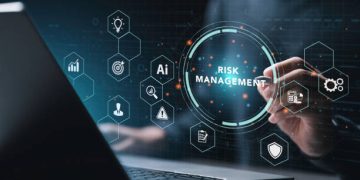






Artificial intelligence (AI) is playing an increasingly significant role in transforming how organizations manage and assess risk. Technologies such as generative AI and agentic AI are enabling companies to move beyond traditional approaches toward more dynamic, data-driven risk management frameworks.
Conventional risk management methods, often based on manual processes and retrospective analysis, are gradually being replaced by systems that can learn from data, adapt to changing conditions, and support decision-making in near real time. According to KPMG’s “Future of Risk Survey,” executives identified AI and generative AI as the most widely favored technologies for managing additional risk responsibilities over the next three to five years.
Risk teams have already been using AI-driven tools such as automation and advanced analytics for several years. Survey findings indicate that 98 percent of respondents reported improvements in risk identification, monitoring, and mitigation as a result of digital acceleration, including AI and advanced analytics. As capabilities evolve, organizations are exploring how newer AI technologies can deliver deeper insights, automate workflows, and improve efficiency across risk operations.
Industry observers note that differences in adoption strategies are shaping outcomes. Some organizations are implementing limited “point-in-time” solutions that automate individual tasks while leaving broader processes unchanged. Others are embedding AI across the entire risk lifecycle, integrating systems to support end-to-end decision-making. This shift aims to move risk management from production-heavy processes to more decision-driven models, where AI supports analysis and operational oversight.
As AI capabilities advance, organizations are also evaluating stages of maturity in risk management adoption. Early-stage deployments often involve experimentation with automation, machine learning, or AI tools without full-scale production use. As adoption progresses, organizations implement siloed solutions focused on specific activities, followed by integrated systems connected to governance, risk, and compliance frameworks with human oversight.
More advanced stages include agentic AI deployments, where end-to-end risk processes are increasingly automated. At the highest level of maturity, AI contributes to fundamental changes in risk frameworks, replacing traditional methodologies with data-driven and predictive approaches.
At the same time, organizations deploying AI-powered products are encountering operational and compliance challenges. Product approval processes, model risk requirements, and regulatory considerations can slow implementation timelines. This dynamic highlights the dual role of AI as both an enabler of efficiency and a source of new oversight requirements.
Risk teams are therefore expanding their responsibilities to include managing risks associated with AI itself. While AI can help reduce costs, automate compliance, and uncover insights, it also introduces considerations related to governance, transparency, and accountability. As a result, organizations are developing new controls and monitoring practices to manage AI-related risks.
In the Philippines, organizations are beginning to adopt AI tools to enhance risk management and operational resilience. Some telecommunications providers are using automation and data analytics to monitor network traffic, detect potential fraud, and reduce service disruptions. These early applications focus primarily on operational improvements but also demonstrate how AI can support real-time risk monitoring.
Industry experts note that these initial deployments may serve as a foundation for broader adoption. As AI systems become more integrated, organizations may transition from isolated solutions to connected platforms capable of detecting risks, generating insights, and supporting strategic decision-making.
As adoption expands, risk management functions are shifting from process-oriented roles toward supporting informed decision-making. Organizations that combine AI capabilities with governance frameworks and accountability structures are expected to strengthen resilience and improve their ability to manage uncertainty.
#SupplyChainNews #RiskManagement #ArtificialIntelligence #DigitalTransformation #CyberRisk