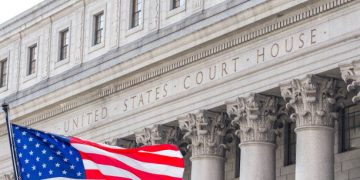






A US federal appeals court has issued a temporary administrative stay on a lower court decision that had blocked President Donald Trump’s 10 percent global tariff, keeping the policy in effect while legal proceedings continue.
The case focuses on whether the tariff, imposed under Section 122 of the 1974 Trade Act, falls within the limits of presidential authority. A coalition of 24 US states has challenged the measure, arguing that the administration did not meet the legal conditions required under the law and that the policy exceeds executive power.
Trump introduced the 10 percent import tariff in January as part of a broader trade policy shift. The move followed a previous Supreme Court ruling that invalidated earlier tariffs justified under the International Emergency Economic Powers Act (IEEPA). In that decision, the court stated that the law does not grant the president authority to impose broad, blanket tariff measures, as had been argued by the administration at the time.
More recently, the US Court of International Trade ruled in a 2–1 decision that the requirements under Section 122 were not satisfied. The court said the presidential proclamation did not properly establish the necessary conditions and therefore found the tariffs to be unauthorized by law. The appeals court’s temporary stay pauses that ruling, giving the administration time to respond as the case moves forward.
The legal challenge has become a significant test of the boundaries of executive authority in trade policy. The states involved argue that the tariffs place a financial burden on both consumers and businesses, pointing to rising costs as evidence of their impact. Washington State Attorney General Nick Brown has said that American consumers are ultimately the ones absorbing the cost of the tariff measures.
Economic indicators have shown price increases in several consumer goods categories since the tariff implementation. A recent consumer price index report noted that apparel and electronics prices rose by 0.6 percent, while prices for toys and furniture increased by 0.8 percent. Analysts have pointed to these movements as part of broader inflationary pressure affecting household spending.
The policy itself remains time-limited under Section 122, with the 10 percent tariff set to expire in July unless extended by Congress. Even if extended, the law caps its duration at 150 days, adding further uncertainty to the long-term direction of the measure.
In parallel, US Customs and Border Protection is already processing refunds linked to tariffs previously imposed under IEEPA. The agency estimates repayments totaling $35.46 billion across approximately 8.3 million shipments as of Monday, highlighting the scale of adjustments already underway.
The outcome of the ongoing court case is expected to shape not only the future of the current tariff policy but also how far presidential authority can extend in setting broad trade measures.
#USEconomy #TradePolicy #Tariffs #USCourts #Inflation