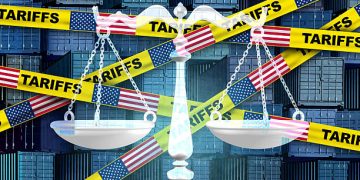






The Donald Trump administration has proposed a sweeping new round of import tariffs in mid-2026, escalating trade pressure on dozens of global economies under the stated goal of addressing forced labor violations and strengthening domestic manufacturing resilience. The proposal, led by the Office of the United States Trade Representative, would impose additional duties in the range of 10% to 12.5% on imports from roughly 60 trading partners, marking one of the most expansive trade enforcement actions in recent years.
The policy framework relies primarily on Section 301 authority, which allows the U.S. to respond to unfair trade practices, and is being paired with updated Section 232 measures covering strategic materials such as steel, aluminum, and copper. Together, these actions are designed to reinforce national security-linked supply chain independence while also pressuring foreign governments to tighten enforcement against forced labor practices in global production networks.
Major economies affected by the proposal include China, members of the European Union, Canada, Mexico, the United Kingdom, Japan, and Brazil. While some countries may qualify for reduced tariff rates or exemptions, eligibility would depend on demonstrable enforcement of labor and supply chain compliance standards, creating a new tiered trade structure that rewards regulatory alignment with U.S. expectations.
The announcement also comes amid heightened signaling from the administration regarding digital trade policy. Additional threats of tariffs as high as 100% have been floated for countries that impose digital services taxes on major U.S. technology firms, further widening the scope of potential trade conflict beyond traditional goods into the digital economy.
Economists warn that these measures could place significant strain on deeply integrated supply chains, particularly across North America under the United States-Mexico-Canada Agreement framework. Industries such as automotive manufacturing, electronics assembly, and consumer goods production—where components frequently cross borders multiple times—are expected to face higher compliance costs, delays, and pricing pressures.
Canada and Mexico are already being closely watched for potential retaliatory measures, as both countries assess how new tariff layers might interact with existing trade commitments. Any escalation could risk fragmenting one of the world’s most tightly integrated regional production systems.
As of late June 2026, negotiations remain ongoing, but uncertainty is rising across global markets. Importers are accelerating efforts to map exposure across supply chains, re-evaluate sourcing strategies, and adjust contracts in anticipation of stricter customs enforcement and higher landed costs.
The proposals also include limited flexibility for certain sectors, such as textiles, where quota-based reduced-rate structures may be introduced. However, analysts note that even with carve-outs, the broader direction signals a more restrictive and enforcement-heavy trade environment.
Overall, businesses are preparing for a period of heightened volatility, where trade policy, geopolitical tensions, and supply chain restructuring increasingly overlap, reshaping global commerce in real time.
#US tariffs #ForcedLaborTariffs #Section301 #TradeWar2026 #TrumpTariffs