


• Latest
  • Trending
  • All
  • Industry
  • Compliance
  • Global Trade
  • Industry
  • Sustainability & Ethics
  • Video
  • Security & Risk
Tariffs Drive Up Costs and Shortages for U.S. Consumers

Tariffs Drive Up Costs and Shortages for U.S. Consumers

10/20/2025
Ghana Investment & Trade Week 2026 Set to Deliver Next-Level Investment and Trade Partnerships in West Africa

Ghana Investment & Trade Week 2026 Set to Deliver Next-Level Investment and Trade Partnerships in West Africa

03/05/2026
Central Asian Firms Strengthen Compliance Amid Rising Global Sanctions

Central Asian Firms Strengthen Compliance Amid Rising Global Sanctions

03/02/2026
EFTA–Singapore Digital Economy Agreement Enters into Force for Singapore and Norway

EFTA–Singapore Digital Economy Agreement Enters into Force for Singapore and Norway

03/02/2026
China Warns of National Security Risks From Third-Party Data Hosting After Overseas Cyberattack

China Warns of National Security Risks From Third-Party Data Hosting After Overseas Cyberattack

03/02/2026
India and Israel Agree to Expand Trade, Investment and Technology Cooperation

India and Israel Agree to Expand Trade, Investment and Technology Cooperation

03/02/2026
Oil Prices Surge Amid Middle East Disruptions

Oil Prices Surge Amid Middle East Disruptions

03/02/2026
UNR Med Integrates Artificial Intelligence into Medical Education

UNR Med Integrates Artificial Intelligence into Medical Education

02/27/2026
Argentina and Uruguay Ratify Mercosur–EU Trade Deal

Argentina and Uruguay Ratify Mercosur–EU Trade Deal

02/27/2026
Gartner Report Examines Agentic AI’s Impact on Supply Chain Roles

Gartner Report Examines Agentic AI’s Impact on Supply Chain Roles

02/27/2026
Ecuador Raises Tariffs on Colombian Imports to 50%

Ecuador Raises Tariffs on Colombian Imports to 50%

02/27/2026
Court Deadline Looms on Tariff Refunds

Court Deadline Looms on Tariff Refunds

02/27/2026
U.S. Plans Tariff Hike to 15% for Certain Nations, Raising Supply Chain Implications

U.S. Plans Tariff Hike to 15% for Certain Nations, Raising Supply Chain Implications

02/26/2026
supplychainreport
Thursday, March 12, 2026
  • Home
  • Industry
    • Supply Chain
    • Logistics & Transportation
    • Importing & Exporting
    • Manufacturing
    • Warehousing & Distribution
  • Compliance
    • Supply Chain Transparency
    • Anti-Money Laundering (AML)
    • Know Your Customer (KYC)
    • Risk Management
    • Export Controls
    • Sanctions
  • Global Trade
    • Market Trends
    • Economic Indicators
    • Sourcing
    • Trade Policies
    • International Relations
    • Trade Agreements
    • Tariffs & Duties
    • Import/Export Statistics
  • Luxury Goods
  • Industry
    • Blockchain in Supply Chain
    • Importing & Exporting
    • Automation & Robotics
    • Artificial Intelligence in Trade
    • Data & Analytics
  • Sustainability & Ethics
    • Green Supply Chains
    • Sustainable Logistics
    • Ethical Sourcing
    • Corporate Social Responsibility
    • Environmental Policies
  • Security & Risk
    • Cybersecurity in Trade
    • Fraud & Scams
    • Risk Mitigation
    • Security Protocols
    • Data Protection
  • ITC News
    • ITC Featured Members
    • ITC Business Councils Highlights
  • Events
    • Upcoming Conferences
    • Upcoming FREE Educational Webinars
No Result
View All Result
supplychainreport
No Result
View All Result

Tariffs Drive Up Costs and Shortages for U.S. Consumers

by Daisy Mae D.
10/20/2025
in Tariffs & Duties

Supply Chain Repot – 10/20/2025
Across the United States, consumers are feeling the effects of newly implemented tariffs that have led to rising prices, limited product choices, and significant changes in household spending patterns. Many families report that essentials such as groceries, personal care products, and household goods have become noticeably more expensive in recent months.

For many, these price increases are affecting daily routines. Paige Harris, a teacher’s assistant from Stella, North Carolina, said she has been forced to cut back on her family’s grocery list due to increasing costs. “Items that I have bought regularly have gone up in price steadily,” she said. “From hair dye to baby formula, everything is more expensive. Our grocery list has gotten smaller while our budget has had to increase. Meats like steak are a no-go for our household.”

YOU MAY ALSO LIKE

Ecuador Raises Tariffs on Colombian Imports to 50%

Court Deadline Looms on Tariff Refunds

Harris is one of many Americans who have noticed that the price of goods has not aligned with expectations of affordability. While some consumers initially hoped tariffs would boost domestic manufacturing and stabilize the economy, many now express frustration that they seem to be paying more instead.

A recent report from S&P Global estimated that companies are likely to face at least $1.2 trillion in additional costs in 2025, a significant increase from previous projections. Analysts say a large portion of that burden—around $900 billion—will likely fall on consumers in the form of higher prices. Similarly, a study by the Yale Budget Lab calculated that tariffs could add an average of $2,400 per year to household expenses across the United States.

For retirees and low-income earners, the impact has been especially difficult. Jean Meadows, a 74-year-old retiree from Huntsville, Alabama, said she has changed how she shops to manage rising prices. “Prices are way too high. I mostly shop at Costco and buy as little as possible anywhere else,” she said. “I think people are really afraid of what’s coming.”

That fear is reflected in a national survey conducted for the Guardian, where respondents identified tariffs as one of the top economic threats facing the country. The poll revealed growing anxiety about affordability and access to essential products, particularly among retirees and families with fixed incomes.

Myron Peeler, a retiree in Florida caring for his wife, shared similar struggles. “The bread I buy has doubled in price within a year. We live on a fixed income that doesn’t keep up with inflation,” he said. “Everything—from groceries to our electric bill—costs more than before.”

Meanwhile, the White House has stated that the tariff measures are part of an ongoing strategy to encourage domestic production and secure additional revenue from trade partners. Officials maintain that these policies will help strengthen the U.S. economy in the long term.

However, not all Americans are optimistic. Michele, a resident of northeastern Pennsylvania, said shortages of affordable goods are becoming more common. “We need to buy new tires for a car, and can’t, because affordable options are no longer in stock,” she said. “The ones that are available now cost around $250 each, which is beyond our budget.”

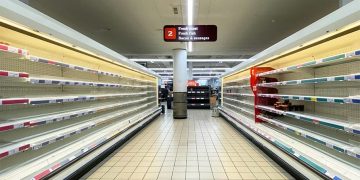
In several regions, shoppers report encountering “empty shelves and higher prices.” Natalie, a semi-retired woman from New Hampshire, said the selection in local stores has declined noticeably. “The store shelves have become more and more bare,” she explained. “Instead of multiple choices, there may only be one or two. Even name brands are being replaced by store brands.” She added that pet food and basic groceries have increased dramatically in price. “One wet cat food my cats like went from $1.79 to $2.49 per can,” she said.

Consumers like Minnie, a food writer from Portland, Oregon, say they’ve had to make major adjustments to their lifestyles. “I don’t shop for non-essentials anymore,” she said. “No fall shopping trips for new clothes. We’ll make all our Christmas presents this year. We used to dine out once a week. Now we never eat out. Even fast-casual is too expensive. Everything is twice what it used to cost.”

Despite the national inflation rate holding at around 2.9%, experts note that the effect of tariffs can be uneven across sectors. For example, goods that rely on imported materials—such as electronics, household appliances, and car parts—are among the hardest hit, leading to shortages and price hikes in local markets.

For Cassie, a 25-year-old consultant from Siler City, North Carolina, the change has been dramatic. “I used to spend about $65 a week on groceries,” she said. “Now, with the new tariffs, I need to visit four different stores across town just to find affordable prices. Sometimes I drive to other towns to find items that are out of stock locally.”

During the summer, Cassie said her local supermarkets experienced shortages of imported produce. “When tariffs were placed on Mexico and Latin America, bananas disappeared from shelves for nearly two weeks,” she recalled. “No one in my area could find any.”

Many consumers say they are bracing for a “new normal” where higher prices and limited product choices become part of everyday life. Some express concern that the long-term effects of tariffs could slow consumer spending, weaken purchasing power, and strain already tight household budgets.

Economists have noted that while tariffs can protect domestic industries in some cases, they also tend to increase costs for both businesses and consumers. With additional measures expected later this year, analysts predict continued uncertainty in consumer markets through 2026.

As the debate continues, one thing remains clear: many Americans are already adjusting their lives around the higher costs of living. Whether through reduced shopping, homemade gifts, or cutting back on dining out, families across the country are adapting to an economic shift that has reached far beyond trade statistics.

#EconomicUpdate #USMarkets #TradePolicy #InflationWatch #ConsumerImpact

ShareTweet

Share Your News

Whether it’s a groundbreaking achievement, a heartwarming tale, or an insightful perspective, we want to hear it. Share your news with us, and let’s amplify your voice in the digital symphony of stories.

Submit

A man is riding a bike on a hill.

The Supply Chain Report is your essential daily news website, serving as a trusted source for comprehensive coverage of the complex and ever-evolving global supply chain dynamics. Our expert team delves into the intricacies of international trade, manufacturing, logistics, importing, exporting, and supply chain management; providing in-depth analysis and up-to-date news on the latest trends, disruptions, and technological advancements affecting industries worldwide. From detailed reports on international trade through to insights into procurement strategies and inventory management, we offer valuable content that helps professionals stay informed and make knowledgeable decisions in a fast-paced market.

Each day, we bring you cutting-edge news and expert commentary that dissect significant international trade and supply chain issues Our coverage spans a wide array of sectors including manufacturing, retail, healthcare, food, consumer goods, and technology, ensuring that no matter your field, you have the strategic information needed to navigate the challenges and opportunities of today’s supply chain landscape. By synthesizing complex data and presenting actionable insights, The Supply Chain Report empowers business leaders, policymakers, and logistics professionals to optimize their operations and drive forward with confidence in an interconnected world.

Connect With Us

  • About
  • Events
  • Privacy Policy
  • Contact Us

© 2024 International Centre for Trade Transparency Limited. Incorporated in the United Kingdom.

No Result
View All Result
  • Home
  • Industry
    • Supply Chain
    • Logistics & Transportation
    • Importing & Exporting
    • Manufacturing
    • Warehousing & Distribution
  • Compliance
    • Supply Chain Transparency
    • Anti-Money Laundering (AML)
    • Know Your Customer (KYC)
    • Risk Management
    • Export Controls
    • Sanctions
  • Global Trade
    • Market Trends
    • Economic Indicators
    • Sourcing
    • Trade Policies
    • International Relations
    • Trade Agreements
    • Tariffs & Duties
    • Import/Export Statistics
  • Luxury Goods
  • Industry
    • Blockchain in Supply Chain
    • Importing & Exporting
    • Automation & Robotics
    • Artificial Intelligence in Trade
    • Data & Analytics
  • Sustainability & Ethics
    • Green Supply Chains
    • Sustainable Logistics
    • Ethical Sourcing
    • Corporate Social Responsibility
    • Environmental Policies
  • Security & Risk
    • Cybersecurity in Trade
    • Fraud & Scams
    • Risk Mitigation
    • Security Protocols
    • Data Protection
  • ITC News
    • ITC Featured Members
    • ITC Business Councils Highlights
  • Events
    • Upcoming Conferences
    • Upcoming FREE Educational Webinars

© 2024 International Centre for Trade Transparency Limited. Incorporated in the United Kingdom.
