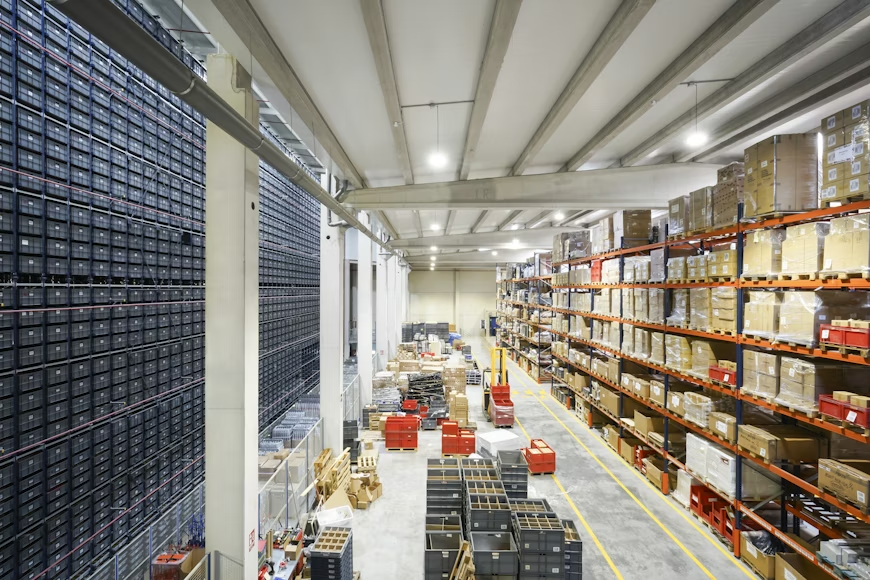






The global warehousing industry is increasingly highlighting the need for a new economic strategy as evolving market dynamics challenge traditional storage and logistics models. Decision‑makers and industry analysts say that warehousing — long treated as a cost centre — must be repositioned as a strategic asset that enhances resilience and competitiveness across supply chains.
The urgency for a refreshed economic framework stems from several converging pressures: shifting demand patterns, continued growth of e‑commerce, inflationary cost environments, and tighter labour markets. In response, thought leaders within the sector argue that warehousing strategy must move beyond footprint optimisation to embrace flexibility, technology integration and long‑term value creation.
Warehouse space is no longer just a buffer for seasonal stock levels — it is increasingly viewed as a risk‑management lever capable of smoothing volatility in supply networks. Operators and logistics planners now see on‑premise storage and fulfillment assets as integral to service levels, rapid fulfilment expectations, and regional responsiveness. However, many current business models remain overly dependent on static revenue from square footage, which may not align with complex, real‑time market demands.
Industry trends indicate that demand for warehousing continues to shift: facilities are becoming more multifunctional, integrating processing, returns handling and value‑added services. Global markets also reflect broader economic forces, with significant absorption of warehouse space driven by manufacturing growth and omni‑channel retail expansion in key regions.
At the same time, technology adoption — from automation to AI‑driven forecasting and inventory optimisation — is reshaping cost structures and redefining what warehousing profitability looks like. Many firms now recognise that automation is no longer purely a productivity play; it is critical to retaining throughput performance while mitigating labour cost pressures.
Experts advocate that governments and private stakeholders alike should work toward policies and investment strategies that prioritise digital transformation, scalable infrastructure and workforce development in warehousing. A more strategic approach could help unlock long‑term economic growth while ensuring that logistics infrastructure continues to underpin global trade and supply chain resilience.